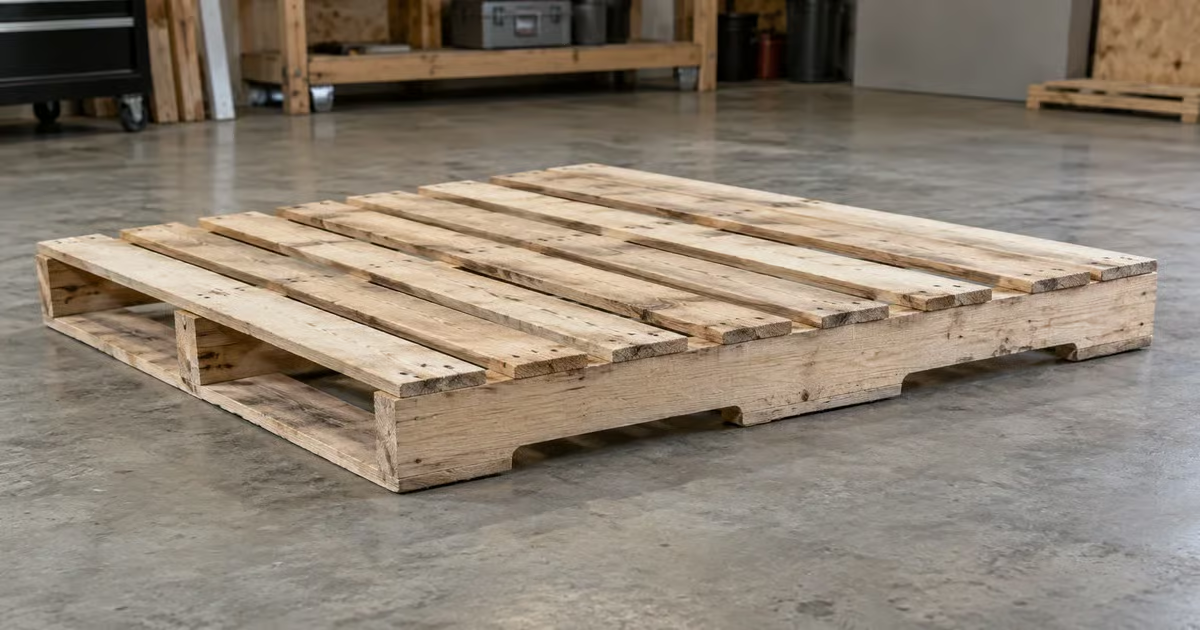
Pallets move almost everything in American commerce. From food distribution centers in the Midwest to automotive parts warehouses along the Gulf Coast, wooden pallets are the foundational unit of how goods are stored, transferred, and shipped. Yet despite their ubiquity, pallets are rarely standardized in condition when they arrive at a facility. Some are structurally sound. Others are damaged, repaired, or nearing the end of their functional life. The gap between a pallet that works and one that fails mid-operation is not always visible at a glance.
For freight managers operating at scale, that inconsistency creates real problems. Load failures, product damage, equipment jams, and workplace injuries are not random events. They are often traceable to a single factor: using the wrong pallet for the task at hand. Without a clear way to evaluate pallet condition before use, procurement decisions become guesswork and operational risk accumulates quietly until something goes wrong.
The five-grade classification system exists precisely to eliminate that guesswork. It gives freight teams, buyers, and logistics planners a shared language for describing pallet condition objectively, and it provides a practical framework for matching the right pallet to the right application before the load ever leaves the dock.
What Pallet Grading Actually Measures and Why It Matters
Pallet grading is a structured evaluation process that assesses the physical condition of a pallet across multiple points of structural integrity. It is not a simple visual check. A proper grading review accounts for deck board damage, stringer condition, block integrity, moisture exposure, repair history, and load-bearing consistency. The outcome is a grade designation that communicates what a pallet can reliably do, rather than just what it looks like. For an operational reference on how condition assessment connects to quality standards, the framework around pallet grading offers useful grounding for facilities looking to formalize their intake processes.
What makes this system practically useful is that it moves pallet evaluation away from subjective judgment. When a receiving team member says a pallet looks “fine,” that assessment is difficult to verify, document, or act on. When that same team member identifies a pallet as a Grade 2 or Grade 3 based on defined criteria, the assessment becomes consistent across shifts, facilities, and vendors. That consistency is the foundation of any reliable pallet management program.
The Connection Between Grade and Load Risk
Each grade level corresponds not just to appearance but to functional capacity. A pallet’s grade reflects whether it can safely carry the weight and movement demands placed on it in a specific application. A pallet that passes a Grade 1 inspection is expected to perform consistently under dynamic loads, meaning it should hold up through forklift movement, racking, and stacking without unexpected failure. A pallet at the lower end of the grading scale may hold weight on a flat surface but fail when tilted, lifted at speed, or racked at height.
The risk is not always immediate. Structural compromise in a pallet can develop progressively. A cracked stringer or a loose deck board may not cause failure on the first use, but repeated loading accelerates degradation faster than expected. By the time failure occurs, the pallet has often already passed through multiple hands and applications it was not suited for. Grade-based evaluation catches that risk at the point of intake, not after the fact.
How the Five Grades Are Defined in Practice
The five-grade system used across US freight and distribution operations provides a spectrum from premium-condition to end-of-life classification. Each grade carries operational implications that go beyond aesthetics. Understanding what separates each level is what allows freight managers to apply the system reliably in day-to-day operations.
Grade A: New or Near-New Condition
Grade A pallets are typically new or have seen only limited use in controlled environments. They show no structural damage, no missing components, and no significant wear patterns. These pallets are suited for the most demanding applications, including pharmaceutical distribution, food-grade facilities, automated conveyor systems, and high-rack storage where uniformity and reliability are non-negotiable. Because Grade A pallets carry a higher cost, using them across all applications regardless of need is an inefficient allocation of procurement resources.
Grade B: Used but Structurally Sound
Grade B pallets have been used but remain fully functional without structural compromise. Minor cosmetic wear is acceptable at this level, including light surface staining or small scuffs, but no broken boards, missing components, or repaired sections should be present. Grade B is the standard workhorse classification for most general freight operations. They work reliably in floor storage, standard racking, and ground-level shipping, and they represent the best balance of cost and performance for high-volume distribution environments.
Grade C: Repaired or Noticeably Worn
Grade C pallets have undergone repair or show meaningful wear that affects their uniformity, even if they retain basic structural integrity. A board replacement, a minor stringer repair, or visible weathering places a pallet in this category. These pallets are not necessarily unsafe for all uses, but they require more careful application. They are typically appropriate for light-load floor storage, single-use outbound shipping, or internal transfers where controlled conditions reduce the risk of unexpected stress. Grade C pallets should not be placed in automated systems or high-rack applications where dimensional inconsistency creates equipment or safety problems.
Grade D: Compromised but Partially Usable
Grade D pallets have multiple areas of damage or significant repairs that raise questions about consistent performance. They may have missing boards, heavily weathered wood, multiple stringer repairs, or uneven surfaces that make them unreliable for standard freight use. Some facilities retain Grade D pallets for temporary staging, light blocking, or low-stress internal applications. However, using Grade D pallets outside of those controlled contexts introduces meaningful liability. Any facility using Grade D pallets regularly in general operations is accepting a level of risk that tends to surface as damage claims, equipment issues, or workforce safety incidents.
Grade F: End-of-Life and Non-Serviceable
Grade F pallets are no longer fit for use in any freight application. Broken stringers, missing deck boards, split blocks, or compromised structural integrity across multiple points are characteristic of this classification. These pallets should be removed from circulation and either sent for recycling or broken down for material recovery. Keeping Grade F pallets in the active inventory, even for temporary use, is a common source of unreported product damage and near-miss incidents in warehouse environments. The cost of removing them from circulation is consistently lower than the cost of the problems they cause when they stay in it.
Applying the Grading System Across Procurement and Operations
Knowing what each grade means is only useful if the grading process is applied consistently at the point of receipt, before pallets enter active inventory. This requires facilities to establish intake protocols that include inspection checklists, grade assignments, and segregation practices that keep different grade levels physically separated in storage. When pallets from multiple sources mix without grade tracking, the effective classification of the inventory becomes unknown, which defeats the purpose of having a grading system at all.
The National Institute of Standards and Technology provides broader measurement and standardization guidance that underscores why consistent classification systems across industrial supply chains reduce both operational and commercial risk. The same principle applies directly to pallet management: a shared, documented standard reduces variability and its associated costs.
Grading as a Procurement Specification Tool
One of the most practical uses of the five-grade system is in vendor negotiations and purchasing contracts. When a freight manager specifies Grade A or Grade B pallets in a procurement agreement, the grade designation becomes a measurable deliverable. Vendors who supply below-grade inventory can be held to account, and receiving teams have a clear benchmark for rejection decisions. Without grade specifications in procurement language, pallet quality becomes entirely dependent on vendor discretion, which is inconsistent by nature.
Facilities that formalize pallet grading into their purchasing terms consistently report fewer disputes over incoming pallet condition, fewer unexpected equipment maintenance events tied to pallet failure, and better predictability in their material handling costs over time.
Grade-Based Routing Within the Facility
Beyond procurement, the grading system supports smarter routing decisions within the facility itself. Grade A pallets should be reserved for high-demand applications. Grade B pallets can handle standard operations. Grade C pallets can be directed toward lighter-duty internal tasks. This intentional routing extends the usable life of higher-grade inventory while reducing the total cost of pallet management across the operation.
Facilities that treat all pallets as equivalent regardless of condition tend to burn through higher-grade inventory faster than necessary, while simultaneously putting lower-grade pallets into applications they cannot reliably support. The result is both wasteful and operationally risky. A simple routing protocol based on grade assignment addresses both problems without significant overhead.
Building a More Consistent Pallet Program
The five-grade classification system is not a complex framework. It is a practical tool that provides freight managers with the language and structure to make better decisions about one of the most used and least examined assets in their operation. Pallets are high-frequency, low-attention items in most facilities, which is exactly why they tend to accumulate risk quietly over time.
Formalizing pallet grading at the intake stage, building grade specifications into procurement contracts, and routing pallets by grade within the facility creates a more predictable, lower-risk operation. It reduces product damage, extends equipment life, supports workforce safety, and improves vendor accountability. None of that requires new technology or significant investment. It requires a consistent standard and the discipline to apply it uniformly across every pallet that enters the facility.
For freight managers managing volume at scale, especially those operating across multiple sites or managing diverse vendor relationships, a standardized grading approach is one of the most straightforward ways to reduce operational uncertainty without adding operational complexity. The five grades give every stakeholder in the supply chain a common reference point, and that shared understanding is where reliable pallet management begins.