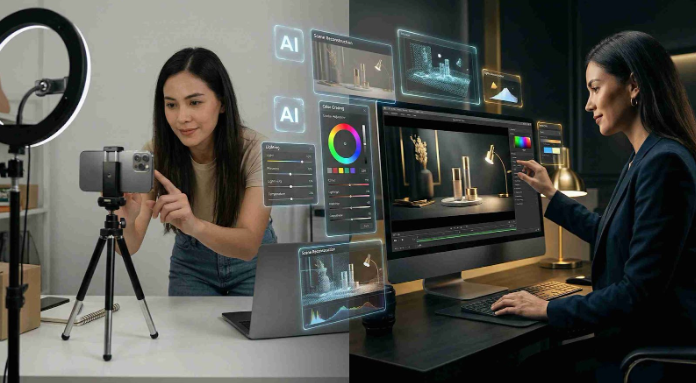
For a long time, high-quality video production was closely tied to budget. Brands with access to studios, equipment, and professional teams consistently produced polished content, while small businesses often had to settle for basic visuals.
In 2026, that dynamic is changing.
Small businesses are now creating video content that looks far more refined and professional, without significantly increasing their budgets. The shift is being driven by changes in how content is produced, rather than how much is spent.
The Traditional Cost Barrier
Producing high-end video content has historically required multiple resources. Cameras, lighting setups, editing software, and skilled professionals all added to the cost.
For small businesses, this created a clear limitation. Even when they had strong ideas, turning them into high-quality visuals was difficult.
As a result, many relied on simpler formats or outsourced production, both of which came with trade-offs.
A Shift Toward Smarter Production Workflows
Instead of relying on physical production setups, businesses are now adopting more streamlined workflows.
Video creation is becoming less about equipment and more about how efficiently ideas can be turned into visuals. Tools that combine scripting, generation, and editing into a single process are making this possible.
This allows small teams to handle production internally without needing multiple tools or external support.
Turning Ideas into Visual Content Faster
Speed plays a major role in this transformation.
Small businesses often need to produce content quickly for marketing campaigns, product launches, and social media. Traditional production timelines make this difficult.
With newer workflows, businesses can move from concept to video much faster. An ai video generator allows teams to generate scenes from prompts, refine motion, and adjust visuals without going through multiple stages of production.
This reduces turnaround time and makes it easier to keep up with content demands.
Achieving a Cinematic Look Without Equipment
One of the key differences between basic and premium content has always been visual quality.
High-end videos often stand out because of controlled camera movement, thoughtful composition, and consistent styling. Replicating this without professional equipment was previously difficult.
Now, businesses can influence these elements directly within the creation process.
Instead of relying on physical cameras, they can define how scenes are framed, how motion behaves, and how the overall visual tone is maintained. This helps create content that feels more polished and intentional.
Consistency Across Campaigns
Consistency is essential for branding.
Large companies maintain consistency through structured production pipelines, but small businesses often struggle to achieve the same level of uniformity.
AI-driven workflows are helping solve this.
Businesses can now maintain consistent visuals across multiple videos by controlling elements like scene transitions, character appearance, and overall style. This ensures that content looks cohesive across campaigns.
In many cases, tools such as Higgsfield make it easier to keep this consistency without needing complex setups or repeated production efforts.
Lower Costs, Better Output
One of the most important benefits for small businesses is cost efficiency.
Instead of investing in equipment, studios, or large teams, they can produce high-quality videos with fewer resources. This allows them to allocate budgets more effectively while still improving content quality.
Lower costs also mean more freedom to experiment. Businesses can test different ideas, formats, and messaging without worrying about production expenses.
Scaling Content for Marketing
Modern marketing requires a steady flow of content.
Small businesses need to produce videos for:
- Social media
- Product promotions
- Advertising campaigns
- Customer engagement
AI makes it easier to scale content production without increasing workload.
Teams can generate multiple versions of a video, adapt content for different platforms, and maintain a consistent publishing schedule.
Competing with Larger Brands
The gap between small businesses and large brands is no longer as wide as it once was.
While larger companies still have more resources, small businesses now have access to tools that allow them to produce content of comparable quality.
This shifts the focus from budget to creativity.
Businesses that can tell compelling stories and connect with their audience effectively can compete regardless of their size.
A New Standard for Business Content
As more businesses adopt these workflows, expectations are changing.
Audiences now expect high-quality visuals from brands of all sizes. This means small businesses can no longer rely on basic content if they want to stand out.
At the same time, they now have the tools to meet these expectations.
The combination of faster production, better control, and improved consistency is setting a new standard for business content.
Conclusion
Small businesses are no longer limited by budget when it comes to video production.
By adopting more efficient workflows and leveraging AI-driven tools, they can produce content that looks polished, consistent, and professional.
This shift is not just improving content quality. It is changing how businesses compete, making it possible for smaller teams to stand out in a crowded digital landscape.
As these tools continue to evolve, the ability to create high-quality video content will become even more accessible, opening new opportunities for growth and creativity.