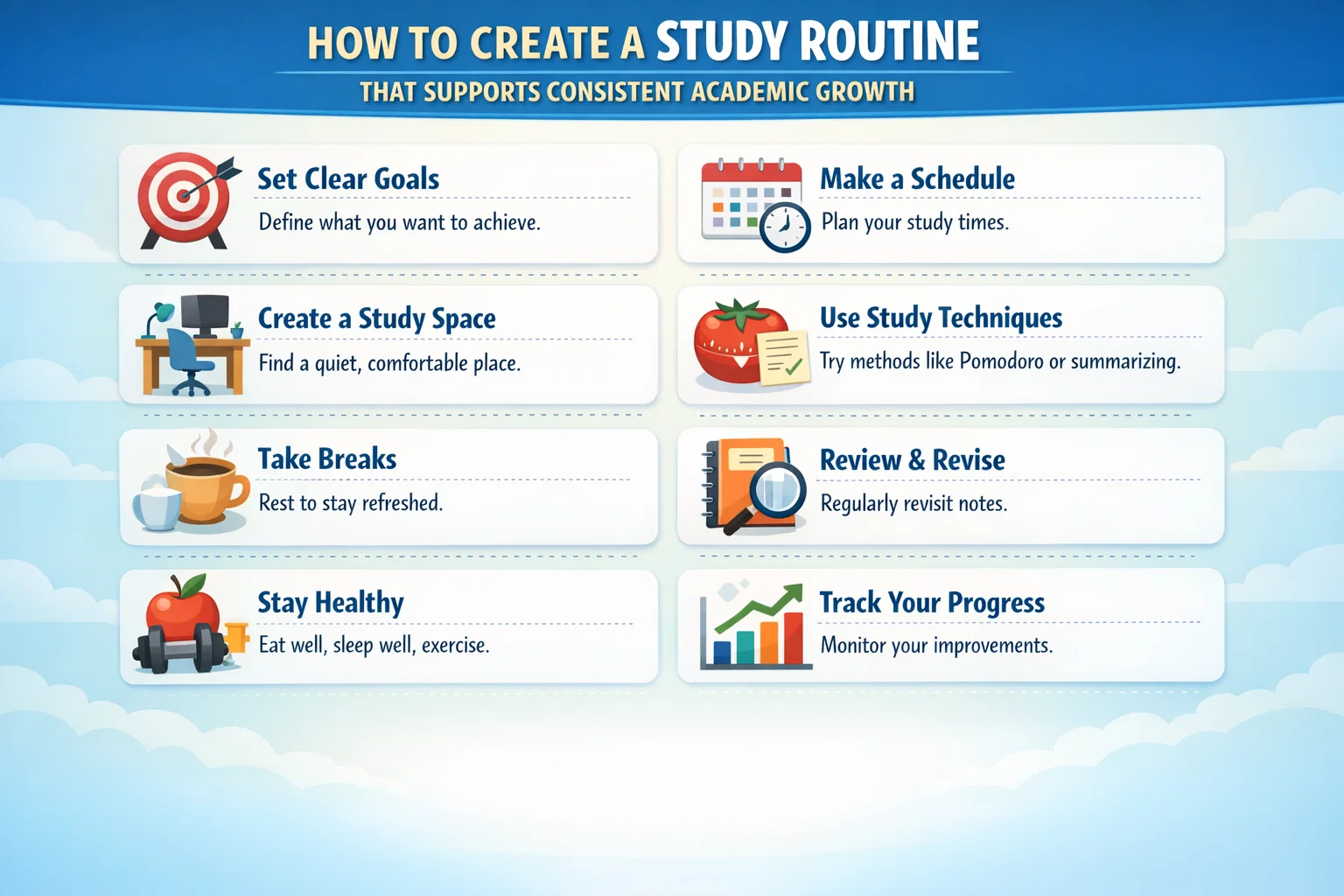
As the academic sector is presently demanding, and on top of that, parents’ expectations are also increasing, it is very important for students to do well academically. Some students achieve better grades than others only by creating and following a study routine that supports consistent academic growth. It is a vital skill that you can develop, but is often overlooked.
While assignments are considered a good way to test your learning, they can also be tough to solve. At that point, if you feel stuck, try to use the do my assignment UK service, where a subject expert will guide you to solve complex questions. Many learners rely on motivation to score better and study intensely right before exams. Consistent academic growth depends on small, repeated actions performed over time. To develop such a mindset, this article will provide you with mini steps you can take to grow academically.
Steps to Develop a Study Routine which Supports Consistent Growth
Making a study routine that supports consistent growth is not a one-time task but a process that evolves with your academic needs. Students struggle to understand or get good academic growth, not because they lack ability, but because they don’t have a structured approach to learning. Without clear steps, studies can often feel dull, irregular, tough and heavy on deadlines or exams. A well-planned study routine will include order, purpose, consistency, and discipline which can turns studies into a daily habit rather than last-minute cramming task.
The steps include building an effective study routine by understanding that consistency is more important than intensity. So by using the steps below, you will be able to create a schedule that boosts consistent growth.
Set Achievable Academic Goal
- Most students become demotivated cause they set academic goals which are not achievable and are hypothetical in nature.
- To set your goals, you have to be specific and clear about what you need to achieve. Instead of thinking that you can cover the whole syllabus to gain knowledge, try to understand each topic one at a time.
- Measure your current abilities and then make goals so that you don’t set overwhelming targets only to be crushed by frustration and burnout.
Assess Current Schedule in Use
- It refers to evaluating how you currently spend your time each day and understand the patterns, habits and routines that can influence your learning.
- Everyone has a specific time of the day when they are more alert and focused. Assessing your schedule helps you pinpoint these periods so that you can schedule your most tough and vital study tasks when your brain is at its sharpest.
- If you need help solving questions, you can use assignment helper It helps you to complete complex questions with ease.
Use Science-Backed Techniques
- There are many science based techniques that, if used correctly, can help increase learning strategies and methods that have been proven through research to enhance memory, comprehension, and retention.
- Active recall is a method in which you actively try to remember information without notes, such as through flashcards or practice questions. It will help you enhance your memory and improve long term memory power.
- Spaced repetition is a method which includes repeated revision of concepts spread over a fixed period. By following it, students can increase their mind and memory abilities.
Find Productivity Tools
- You can increase productivity by using both digital and physical resources, which helps you to organise, manage and optimise your study sessions.For time management tools, use apps like Google Calendar, Notion or Todo lists that help schedule study time and set assignment reminders to complete tasks on time. These tools can even allocate specific time blocks for each task.
- These tools like Trello or AI-powered which can break large assignments into smaller tasks. By doing so, students can reduce the feelings of being overwhelmed.To learn about more tools, kindly visit the Assignment Desk
Prioritise Difficult Subjects
- Tricky tasks are not just time-consuming, but also a way to cut off the interest or motivation of students, and these tasks make studying boring work.
- Begin by assessing which subjects or topics give you academic trouble, whether they are poor test scores, difficulty understanding concepts or slow progress compared to other areas.
- Track improvement subjects that you want to get better at over time. If certain areas remain difficult, change and adjust your approach, not goals.
Track Progress Continuously
- If you assess subjective factors related to study, such as your confidence level in a specific topic, focus quality during class and depth of knowledge you gained, you can know where you lack so that you can work on it.
- While studying, define clear indicators of progress, such as completed chapters, practice test scores, assignment grades or other measurable tasks, so that you get to see your improvement.
- In study sessions, incorporate quizzes and practice tests to evaluate what you understood of a specific topic. Frequent tests allows you to enhance knowledge and find gaps that you should focus on.
Conclusion
A study routine is a primary need that every student should have if they want to succeed academically. Creating a study routine which can support academic growth is not about putting in endless hours of study or following schedules without any flexibility. Instead, it’s about creating a structured, personal system that can balance time, effort and learning methods.
If you have other vital academic-related stuff to do and have less time to solve projects or assignments, use the do my assignment UK services. It will not only save your time, but it will also teach and remove anxiety due to time-constrained tasks.
A good study routine can transform the learning process from a last-minute activity into a proactive and intentional process. Moreover, you need to understand that the key to consistent academic growth lies in both discipline and smart studying activities combined together. Hopefully, you will use the methods discussed above and commit to the approach of getting better academically by understanding the topics and not only remembering them.