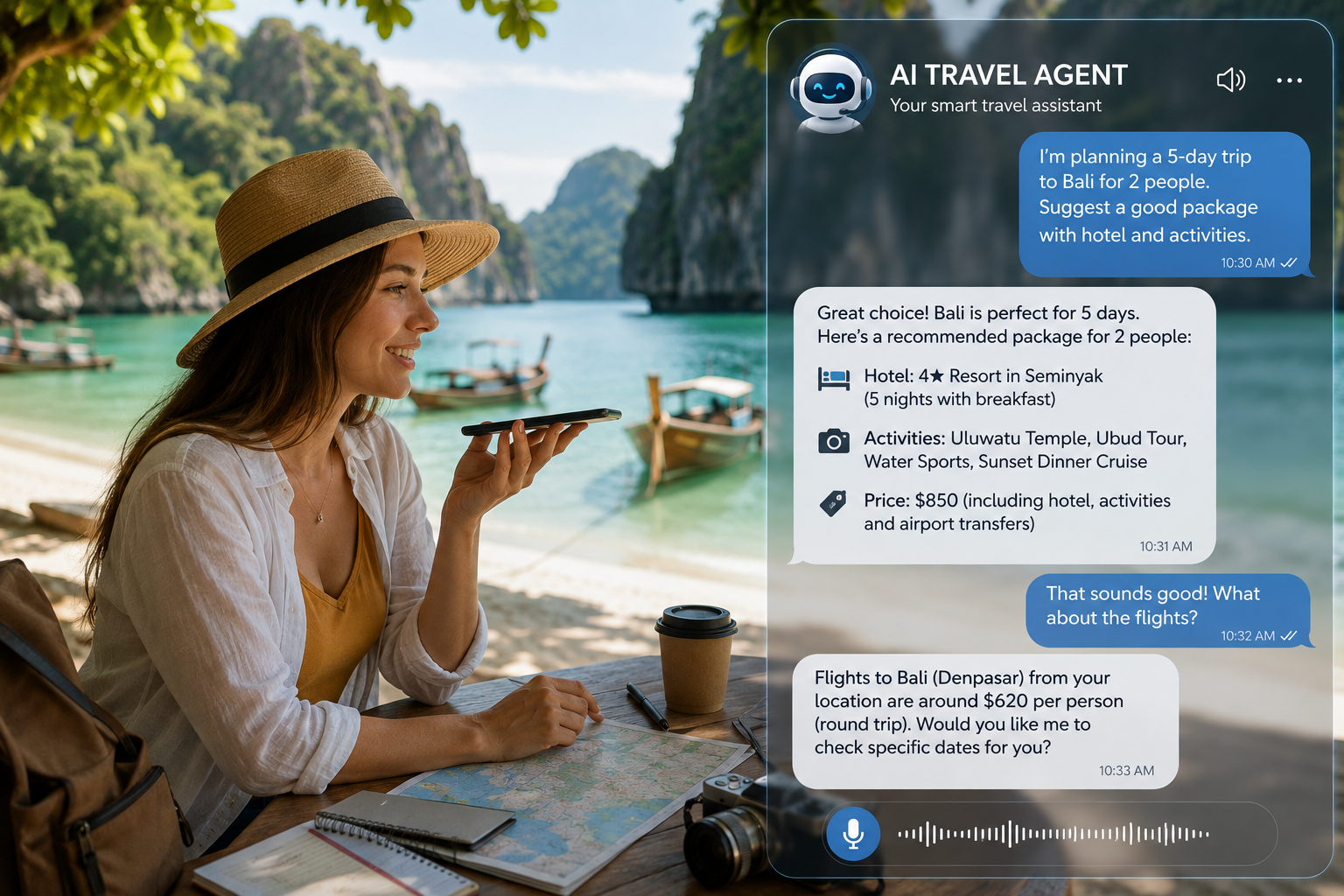
How AI Phone Agents Can Help Travel Companies Convert More Customer Inquiries answer calls, qualify leads, improve customer service, and convert more inquiries into bookings. How AI Phone Agents Can Help Travel Companies Convert More Customer Inquiries is becoming an important topic as travel businesses look for better ways to respond to potential customers and increase bookings. AI phone agents allow travel companies to answer incoming calls, understand customer requirements, recommend suitable travel options, and follow up with interested people without making them wait for a human representative. By handling repetitive conversations and capturing valuable leads, this technology helps travel agencies reduce missed opportunities, improve customer experiences, and turn more inquiries into confirmed bookings.
What Are AI Phone Agents?
AI phone agents are intelligent voice-based systems that communicate with customers through telephone calls. They use speech recognition and conversational artificial intelligence to understand what callers say, respond to questions, and guide conversations naturally. Unlike traditional automated phone systems that ask customers to press numbers to reach different departments, AI phone agents can understand spoken requests and provide relevant answers.
For travel companies, these systems can handle many conversations that would otherwise require a customer service representative. A traveler might call to ask about flight prices, hotel reservations, holiday packages, or available travel dates. The AI agent can collect the necessary details, provide information from connected business systems, and help the customer understand the next steps.
Modern AI phone agents can also connect with customer relationship management (CRM) software, booking platforms, and communication tools. This allows travel businesses to manage inquiries, organize customer information, and maintain contact with potential buyers throughout their booking journey.
Why Travel Companies Need Better Customer Inquiry Management
The travel industry depends heavily on customer communication. People rarely book complicated holidays without asking questions about destinations, accommodation, transportation, prices, and travel arrangements. They want clear answers before spending their money, especially when planning international trips or expensive family vacations.
However, handling every inquiry manually can become difficult when a travel company receives dozens or hundreds of calls. Employees may already be helping existing customers, arranging reservations, or preparing holiday packages. During busy periods, incoming calls can go unanswered, and potential customers may decide to contact another agency.
This creates a problem because every unanswered inquiry represents a possible lost booking. A person calling about a honeymoon package or an upcoming family vacation might already be ready to make a purchase. If the company cannot respond quickly, that customer may find another provider.
AI phone agents help address this challenge by providing faster communication and keeping the inquiry process organized. Instead of allowing calls to go unanswered, travel companies can capture customer requirements and arrange appropriate assistance.
How AI Phone Agents Can Help Travel Companies Convert More Customer Inquiries
AI phone agents can improve several parts of the travel sales process. Their value is not limited to answering calls. They can also identify customer needs, organize potential leads, recommend relevant services, and support follow-up communication.
1. Answer Customer Calls Around the Clock
Travel inquiries do not always arrive during regular office hours. Someone researching an international vacation might call late in the evening after finishing work, while another customer may want to discuss a holiday package during the weekend. If the travel agency is closed, these people may leave a message or contact another company.
AI phone agents can provide 24/7 call coverage, allowing travel businesses to answer inquiries outside normal working hours. They can welcome callers, understand their requirements, answer approved questions, and collect contact information for further assistance. This means a customer interested in booking a vacation does not necessarily have to wait until the next morning to receive an initial response.
2. Reduce Waiting Times for Potential Customers
Long waiting times can affect the way customers view a travel company. People comparing different agencies usually appreciate quick answers, particularly when they are researching several holiday packages at once. If they spend too much time waiting for someone to answer, they may simply hang up and try another provider.
AI phone agents can handle multiple conversations simultaneously, depending on the platform’s capacity. They can immediately respond to routine questions about booking procedures, accommodation options, travel packages, and general company information. This helps customers receive assistance without waiting for an available employee and gives travel consultants more time to handle complicated requests.
3. Qualify Travel Leads Automatically
Not every person contacting a travel agency is ready to book a holiday. Some callers are casually researching destinations, while others have already selected their travel dates and are comparing prices before making a final decision. Understanding this difference helps businesses use their sales resources more effectively.
An AI phone agent can ask relevant questions about the customer’s destination, departure date, number of travelers, budget, and preferred services. For example, someone planning a family vacation to Dubai might need flights and hotel accommodation for four people, while another caller may only be interested in a short weekend trip. By collecting these details during the first conversation, the system helps sales representatives understand customer requirements before following up.
4. Recommend Suitable Travel Packages
Customers do not always know which holiday package is right for them. They may have a destination in mind but need help choosing accommodation, transportation, and additional travel services. Searching through dozens of options can become confusing, particularly when prices and package inclusions vary.
AI phone agents connected to travel inventory or booking systems can retrieve suitable options based on customer preferences. For instance, a couple planning a honeymoon may prefer a peaceful resort with comfortable accommodation, while a family might prioritize larger rooms, convenient transportation, and child-friendly facilities. The AI agent can use these requirements to identify relevant options and explain available packages, helping customers make more informed decisions.
5. Follow Up With Customers Who Have Not Booked
Many potential travelers do not make a booking during their first conversation. They may want to discuss the price with family members, compare other offers, or take a few days to decide. Without proper follow-up, travel companies can lose contact with people who were genuinely interested in their services.
AI phone agents can help organize follow-up calls and reminders based on customer preferences. For example, if someone requests a quotation for a seven-day holiday package, the system can arrange a follow-up after the customer has had time to review the offer. A friendly conversation can remind them about the package and ask whether they need additional information. This keeps communication active without requiring employees to remember every pending inquiry manually.
6. Manage More Inquiries During Peak Travel Seasons
Summer vacations, school holidays, festive periods, and major travel seasons often bring increased demand for travel services. During these times, agencies may receive more calls than their employees can comfortably manage. Even experienced sales teams can struggle to answer every inquiry while handling existing bookings.
AI phone agents provide additional call-handling capacity during busy periods. They can answer routine questions, collect travel requirements, and direct important inquiries to available employees. A customer requesting an urgent international booking can be transferred to a human consultant, while someone asking about general package information can receive an automated response. This helps travel businesses manage demand without depending entirely on additional customer service staff.
7. Support Customers in Multiple Languages
Travel companies often communicate with people from different countries and language backgrounds. A customer may prefer discussing a holiday in Arabic, while another might feel more comfortable speaking English, French, or Spanish. Language barriers can make it difficult to explain booking conditions and travel requirements clearly.
AI phone agents with multilingual capabilities can communicate in supported languages and help international customers understand available services. This can be particularly useful for agencies serving travelers from several regions. However, businesses should test language accuracy carefully, especially when conversations involve destination names, prices, travel dates, and important booking information.
8. Answer Frequently Asked Travel Questions
Travel consultants spend considerable time answering similar questions every day. Customers often ask about baggage allowances, hotel check-in times, airport transfers, cancellation policies, and the documents needed for particular journeys. Although these questions are important, repeatedly answering them can reduce the time available for more valuable sales conversations.
AI phone agents can respond to common inquiries using an approved company knowledge base. A caller asking whether airport transfers are included in a particular package can receive an answer based on the package details stored in the system. Similarly, customers can receive general information about booking procedures and company policies. Information that changes frequently, such as visa rules and entry requirements, should always come from verified and updated sources.
9. Provide More Personalized Customer Experiences
Travel planning is often connected to personal experiences. Someone might be arranging a honeymoon, planning a family reunion, or organizing a long-awaited international vacation. They want recommendations that reflect their actual needs rather than generic sales conversations.
AI phone agents can use customer information and conversation history, where permitted, to make interactions more relevant. If a returning customer previously discussed a family holiday, the system may be able to retrieve those preferences instead of asking the same questions again. It can also suggest related services, such as airport transfers, additional hotel nights, or guided tours, when they genuinely match the customer’s plans.
10. Transfer Complicated Inquiries to Human Employees
Although AI phone agents can manage many routine conversations, some travel situations require human expertise. Customers may need assistance with complicated itineraries, special accommodation arrangements, refund requests, or unexpected travel changes. These situations can involve several decisions that are difficult to handle through automated responses alone.
A well-designed AI phone system can recognize when a customer needs personal assistance and transfer the call to an appropriate employee. It can also provide a conversation summary containing the customer’s destination, travel dates, budget, and previous questions. This allows the human representative to continue the discussion without asking the customer to explain everything again.
How AI Phone Agents Turn Customer Inquiries Into Confirmed Bookings
The real advantage of AI phone agents becomes clearer when their features work together throughout the booking process. Imagine someone visiting a travel agency website and calling to ask about a five-day holiday package. Instead of waiting for an employee, the caller immediately speaks with an AI agent that collects the destination, preferred dates, number of travelers, and estimated budget.
The system then checks the available information through connected business platforms and presents suitable options when the necessary integrations are available. If the customer has questions about package details, the AI agent provides approved information. If the traveler is interested in booking but needs additional guidance, the conversation can be transferred to a sales representative. When the customer is not ready to make a decision, the company can arrange an appropriate follow-up.
This process creates a more organized customer journey. Instead of treating every call as a separate conversation, travel companies can maintain useful customer records and understand which inquiries are more likely to become bookings.
Real-World Examples of AI in the Travel Industry
AI-powered customer service is no longer just an idea for the future. Several companies in the travel industry have already introduced conversational AI to improve customer interactions and manage support requests.
HBX Group
HBX Group, a global B2B travel technology and distribution company, has worked with Google Cloud and Ayesa Digital to automate parts of its telephone support operations. Google’s published case study reports that its intelligent voice channel automates 18% of high-volume live phone interactions. This demonstrates how voice automation can help travel businesses manage repetitive customer requests while allowing employees to concentrate on more complicated inquiries.
Tripadvisor
Tripadvisor has introduced an AI voice agent called Vesper to support customer service operations. The technology can understand customer intent, retrieve information from connected systems, and transfer conversations to human employees when additional assistance is needed. This approach demonstrates how conversational AI can support travel-related customer interactions without removing the option of human help.
loveholidays
Online travel company loveholidays developed an AI assistant called Sandy using Google Cloud technology. The company has used conversational AI to help customers receive answers more quickly and manage support requests. Google Cloud has reported that more than 55% of its customers receive answers to their questions in less than a minute in its published case study. Although this example involves an AI assistant rather than an exclusively telephone-based agent, it highlights the wider potential of AI-powered customer service in travel.
AI Phone Agents vs. Traditional Travel Call Centers
Traditional call centers and AI phone agents both help travel companies communicate with customers, but their capabilities are different. Human representatives bring personal judgment and experience, while AI systems can automate repetitive tasks and provide additional call-handling capacity.
| Feature | Traditional Call Centers | AI Phone Agents |
|---|---|---|
| Availability | Depends on staff schedules | Can operate 24/7 |
| Call handling | Limited by available employees | Can handle multiple conversations |
| Lead qualification | Usually manual | Can collect information automatically |
| Follow-ups | Require employee involvement | Can schedule automated follow-ups |
| Common questions | Answered by representatives | Handled using approved information |
| Complex requests | Managed by human employees | Escalated to human employees |
| Customer records | May require manual updates | Can integrate with CRM systems |
For most travel businesses, combining AI automation with human customer support is a more practical approach than completely replacing traditional call centers. AI can handle repetitive conversations while employees focus on customer relationships and important booking decisions.
How Travel Companies Can Implement AI Phone Agents
Introducing AI phone agents does not require a travel company to change its entire customer service operation immediately. Businesses can start with a few common tasks and gradually expand the system as they understand customer needs.
Identify Common Customer Inquiries
The first step is understanding which questions customers ask most frequently. Travel companies can review incoming calls and identify repetitive topics, such as package prices, hotel facilities, flight information, and booking procedures. These are suitable starting points because they usually follow predictable conversation patterns and can be answered using reliable business information.
Connect the System With Business Software
An AI phone agent becomes more useful when it can access the information required to assist callers. Travel companies may connect it with CRM software, reservation platforms, booking databases, and communication tools. These integrations allow the system to retrieve customer records, organize inquiries, and provide information from relevant business sources. Proper access controls should be used to protect customer data.
Create Natural Conversation Workflows
Customers should not feel as though they are speaking with a complicated automated menu. Travel companies should create simple conversation flows that allow callers to explain their requirements naturally. The system might begin by asking about the destination, followed by the preferred travel date and budget. Keeping questions relevant and easy to understand makes the experience more comfortable.
Establish Clear Human Handoffs
Every AI phone system should have a clear process for transferring conversations to human representatives. If a customer has a complicated request, becomes frustrated, or specifically asks to speak with an employee, the system should make assistance accessible. Providing the representative with a conversation summary can also prevent customers from repeating information.
Monitor Results and Improve Performance
After implementation, businesses should regularly review customer feedback, call outcomes, and booking results. This helps identify problems such as misunderstood questions, incorrect information, and unsuccessful transfers. Travel companies should also update their AI knowledge base whenever package details, booking procedures, or company policies change.
Important Metrics to Measure AI Phone Agent Performance
Travel companies should measure more than the number of calls answered by their AI systems. The main objective is to improve customer communication and generate meaningful business results. Tracking the right performance indicators helps companies understand whether automation is actually contributing to more bookings.
| Performance Metric | What It Measures |
|---|---|
| Call answer rate | Percentage of incoming calls answered |
| Missed inquiry rate | Number of customer calls left unanswered |
| Lead qualification rate | Percentage of inquiries with useful customer information |
| Booking conversion rate | Percentage of qualified inquiries that become bookings |
| Follow-up response rate | Percentage of customers responding to follow-ups |
| Human transfer rate | Percentage of calls requiring employee assistance |
| Customer satisfaction | How customers rate their experience |
| Cost per qualified lead | Average cost of generating a qualified inquiry |
For example, a travel agency might notice that its AI system answers more calls than the previous customer service process. However, the company should also check whether those conversations lead to more qualified inquiries and confirmed reservations. An increase in answered calls is encouraging, but actual booking performance provides a better understanding of commercial value.
Challenges Travel Companies Should Consider Before Using AI Phone Agents
AI phone agents offer several advantages, but businesses should understand their limitations before introducing the technology. An automated system that provides incorrect flight prices, hotel availability, or travel requirements can damage customer trust. Companies should connect AI agents to reliable information sources and clearly define which questions they are allowed to answer.
Customer privacy is another important consideration. Travel inquiries may involve personal information, contact details, and sensitive booking records. Businesses should follow applicable privacy regulations, use appropriate security measures, and avoid collecting unnecessary information. Customers should also be informed about AI interactions where required.
Another challenge is understanding different accents and speaking styles. International travel companies may receive calls from people who pronounce destination names differently or use unfamiliar expressions. Testing the system with realistic conversations can help identify communication problems before a wider launch.
Finally, some customers simply prefer speaking with a human representative. Travel companies should not force callers to remain in automated conversations when they need personal assistance. A reliable human handoff process is essential for maintaining customer confidence.
The Future of AI Phone Agents in the Travel Industry
AI phone agents are likely to become more capable as voice recognition and conversational technology continue to improve. Future systems may handle more complicated travel planning discussions, compare available services across connected platforms, and provide more personalized recommendations based on customer preferences.
Imagine a traveler calling an agency and explaining that they want a seven-day European vacation within a particular budget. An advanced AI phone agent could help understand their requirements, retrieve suitable travel options, provide relevant accommodation information, and arrange a consultation with a travel expert. This could make the early stages of travel planning faster and more convenient.
Integration with WhatsApp, email, website chat, and CRM platforms may also create more connected customer experiences. A traveler could begin a conversation over the phone and later receive relevant booking information through another communication channel, subject to their preferences and consent.
However, human expertise will remain important. Travel planning involves personal expectations, unexpected changes, and decisions that sometimes require careful judgment. The strongest travel businesses will use AI to improve efficiency while keeping human consultants involved when their knowledge and experience are needed.
Conclusion
AI phone agents can help travel companies convert more customer inquiries by making communication faster, improving lead management, and keeping potential customers engaged throughout the booking process. From answering calls outside business hours to recommending relevant travel packages and arranging follow-ups, these systems can support several important stages of the customer journey.
Their biggest advantage is that they allow travel businesses to manage repetitive conversations without taking valuable time away from human consultants. Employees can focus on complex travel arrangements and customer relationships while AI handles routine inquiries.
For travel agencies, tour operators, and larger travel companies, adopting AI phone agents can be a practical way to reduce missed opportunities and improve customer service. The key is to combine reliable automation, accurate travel information, and accessible human support to create a booking experience that customers feel comfortable trusting.
FAQs About AI Phone Agents for Travel Companies
1. How can AI phone agents help travel companies increase bookings?
AI phone agents help travel companies answer customer calls quickly, collect travel requirements, qualify potential leads, recommend relevant packages, and arrange follow-ups. These capabilities reduce missed opportunities and help interested customers move toward completing reservations.
2. Can AI phone agents book flights and hotels?
Yes, AI phone agents can assist with flight and hotel reservations when connected to compatible booking and reservation systems. Depending on their permissions, they can retrieve availability, collect customer details, and guide travelers through the booking process.
3. Are AI phone agents available 24 hours a day?
Yes, many AI phone agent platforms can operate around the clock. This allows travel agencies to answer customer inquiries during evenings, weekends, and public holidays when their regular employees may be unavailable.
4. Can small travel agencies use AI phone agents?
Yes, small travel agencies can use AI phone agents to handle routine calls, collect customer requirements, answer common questions, and organize follow-ups. The most suitable system depends on the agency’s call volume, budget, and software requirements.
5. Do AI phone agents replace human travel consultants?
No, AI phone agents are generally more useful as support tools than complete replacements for human employees. They can manage repetitive tasks, while travel consultants handle complicated itineraries, special requests, booking problems, and important customer decisions.
Read also: GTA 6 Xbox Auto Upload Bans Should You Turn Off Auto Upload